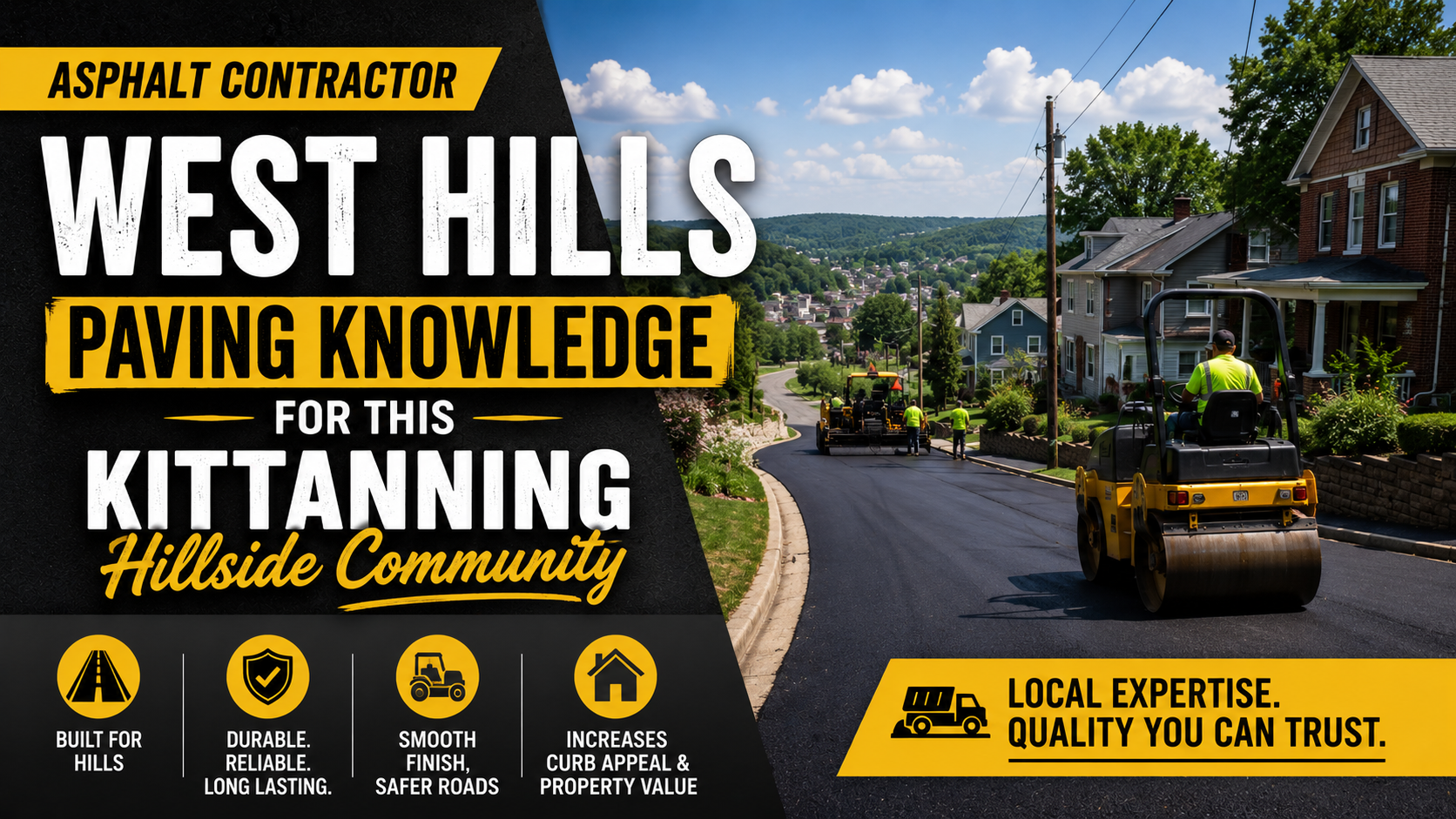
West Hills is an unincorporated community within East Franklin Township in Armstrong County, Pennsylvania. Situated on the elevated terrain west of Kittanning’s downtown core and accessible from routes including Butler Road and other corridors that climb away from the Allegheny River valley, West Hills is a residential area where the landscape itself shapes the challenges that property owners face with paving. Sloped lots, graded driveways, and the drainage dynamics that come with hillside terrain are defining characteristics of Asphalt Contractor West Hills in this part of Armstrong County.
The Hillside Challenge: Why Slope and Drainage Define West Hills Paving
The most significant distinguishing characteristic of paving work in West Hills compared to flatter residential areas is slope. Properties on graded terrain are subject to drainage and structural forces that flat-lot properties simply don’t experience to the same degree. Understanding these forces and how quality asphalt installation accounts for them is fundamental to any West Hills paving project.
Water follows gravity, and on a sloped lot, it follows it quickly and with volume. A driveway on a grade that is not properly pitched in the correct direction, or that lacks edge drainage, becomes a channel for water rather than a surface that sheds it. Water running along the surface of a driveway rather than off it accelerates the deterioration of the asphalt edges. Water that flows beneath the surface rather than away from it saturates the base layer, softening it and allowing it to shift under vehicle loads. In both cases, the result is accelerated pavement failure cracking, edge breakdown, and surface deformation that appear years before they should on a properly installed surface.
Proper grading in a hillside context means more than simply sloping the surface toward one edge. It means understanding how water will flow across the entire lot, where it will concentrate, and where drainage must be directed. For some West Hills properties, this means installing drainage structures French drains, catch basins, or graded swales that capture and redirect water before it reaches the pavement. For others, it means carefully engineering the crown and cross-slope of the driveway to move water efficiently to appropriate discharge points without eroding edges or adjacent landscaping.
Structural Requirements for Sloped Driveways
A sloped driveway is subject to shear forces that a flat one is not. Vehicle braking and acceleration on a grade transfer more stress to the pavement surface than the same loads on flat ground. Over time, inadequate base preparation on a sloped driveway shows up as surface cracking, shoving where the asphalt pushes forward on the slope and edge failures where the lateral support of the pavement is compromised.
Addressing these forces in a West Hills driveway requires adequate base depth and compaction. The stone aggregate base that underlies quality asphalt installations does most of the structural work it distributes loads across the soil beneath, provides drainage within the pavement structure, and resists the shear forces that slope introduces. A base that is too thin, inadequately compacted, or improperly graded will fail under these conditions faster than on a flat site.
Asphalt thickness is also relevant. Residential driveways that see only passenger vehicles can be adequately served by standard asphalt thickness, but properties that receive regular delivery truck traffic, heavy equipment, or RVs may benefit from additional asphalt depth. On sloped driveways, the additional thickness also provides more material to resist the shear forces that grade introduces.
Types of Asphalt Work in West Hills
West Hills property owners seek asphalt contractor services across a range of project types, reflecting the variety of conditions present in this community.
New driveway installation on undeveloped or previously gravel driveways is one of the most significant improvements a West Hills property owner can make. Gravel driveways on sloped lots are particularly susceptible to erosion and surface displacement the same water movement that challenges asphalt on hills actively moves and displaces gravel, requiring constant regrading. A well-installed asphalt driveway on a properly prepared and graded base eliminates these problems and provides a stable, permanent surface.
Complete driveway replacement is appropriate for older asphalt surfaces that have deteriorated beyond the reach of resurfacing. In West Hills, where the terrain has been working against improperly installed driveways for years, full replacement with correct base preparation and drainage engineering provides a fresh start a surface engineered for the actual site conditions rather than simply covering over existing problems.
Resurfacing remains an option for West Hills properties where the base is sound and the drainage situation is acceptable. An overlay adds a fresh wearing course over the existing structure, renewing the surface appearance and performance without the cost of full excavation and replacement. The critical assessment is whether the existing base and drainage are truly adequate, or whether they represent ongoing problems that will compromise the overlay in a few years.
Crack sealing and surface maintenance extend the life of West Hills driveways between major interventions. The seasonal temperature swings of western Pennsylvania’s climate cause asphalt to expand and contract, gradually opening surface cracks. Sealing these cracks promptly prevents water from using them as an entry point to the base layer a particularly important practice in a hillside setting where water already has momentum and is actively seeking downhill paths.
Sealcoating protects the surface from oxidation, water, and contaminants. On hillside driveways, where water flow across the surface is more vigorous than on flat lots, maintaining a well-sealed surface is even more important than in flat settings. A sealed surface resists water penetration more effectively and maintains flexibility through temperature changes better than an oxidized, unsealed surface.
Access and Equipment Planning in West Hills
Working on sloped residential driveways requires equipment planning that flat-lot paving does not always demand. Paving equipment particularly rollers and pavers operates differently on a grade, and the logistics of delivering hot-mix asphalt to a hillside property require planning for truck access and turn-around. Some West Hills properties with longer, narrower driveways present particular challenges in this regard.
A contractor experienced in West Hills and the broader Armstrong County hillside terrain has already worked through these logistics on similar properties. Knowing in advance where equipment will stage, how delivery trucks will approach and exit, and how to sequence the paving work on a sloped surface is part of professional paving planning not something to be figured out on the day of the job.
Armstrong County’s Freeze-Thaw Reality and What It Means for West Hills
Western Pennsylvania experiences a pattern of winter weather that is particularly demanding on pavement: repeated cycles through the freezing point, with temperatures dropping below 32 degrees Fahrenheit at night and rising above it during the day. Each cycle allows any water that has entered cracks or the base layer to freeze, expand, and then melt with each iteration widening the damage. Over a typical Kittanning winter, this process can occur dozens of times.
On a hillside property, this cycle is compounded by the fact that water is actively flowing across and through the pavement during warm portions of the freeze-thaw cycle. This moving water carries more erosive energy than standing water on a flat surface, and it can transport base material over time if drainage paths through or beneath the pavement are not properly engineered.
Armstrong County’s climate also means that paving season is limited. The practical window for asphalt installation in the region runs from late April through October the period during which ambient temperatures are reliably warm enough for hot-mix asphalt to be placed and compacted correctly. Property owners in West Hills who have identified a paving need benefit from planning ahead and getting on a contractor’s schedule early in the season.
What Good Asphalt Work Looks Like Over Time in West Hills
A West Hills driveway that was installed correctly with proper excavation, an engineered base tailored to the slope and drainage conditions, appropriate grading, and quality asphalt material should deliver 20 to 30 years of service with routine maintenance. That maintenance includes periodic sealcoating, prompt crack sealing when cracks appear, and visual inspection after each winter to identify any areas where freeze-thaw cycling has opened new surface defects.
The inverse is also true: a West Hills driveway installed without proper attention to slope, drainage, and base preparation will show its failures within a few years. Surface cracking, edge breakdown, shoving near the bottom of the slope, and water-related base failures are predictable outcomes of installation that didn’t account for the hillside environment. Understanding what distinguishes one from the other and what to look for when evaluating a proposed scope of work puts West Hills property owners in a position to make sound decisions about one of their property’s most visible and functional elements.
Common Questions West Hills Property Owners Ask About Asphalt
Does a sloped driveway need a thicker base? In most cases, yes. The shear forces introduced by a grade from vehicle braking and acceleration place additional stress on the pavement structure. A thicker, well-compacted aggregate base distributes these forces more effectively and provides better resistance to long-term deformation.
What causes shoving on a sloped driveway? Shoving where the asphalt surface appears to have pushed or slid downhill is a sign that the asphalt mix was too soft at installation, that the base was inadequate, or that an overlay was placed over a failed existing surface without addressing the underlying conditions. It is one of the most recognizable signs of a problematic installation on a hillside property.
How often does a West Hills driveway need sealcoating? Every two to three years is the general recommendation for most residential driveways in western Pennsylvania. On a hillside driveway where water flow across the surface is more vigorous, maintaining a sealed surface is particularly important for preserving edge integrity and preventing water from entering the asphalt structure.
Can a gravel lane be converted to asphalt on a slope? Yes, but the transition requires careful assessment of the existing gravel base. If the gravel is well-compacted and properly graded, it may serve as a usable base for asphalt overlay. If it is loose, contaminated with soil, or poorly graded, it must be reworked or replaced before asphalt installation can succeed on the slope.